Why Residents Pay Higher Electric Bills When Data Centers Move In

Opening
Residential utility bills in America “rose 6% on average nationwide in August compared with the same period in the previous year,” reports CNBC, citing statistics from the U.S. Energy Information Administration.
This raises an important question: How does building a data center—something most residents never see or interact with—end up increasing the utility bills of people who receive no direct benefit from it?
At a glance, it feels unfair. Why should a household pay more just because a large corporation decided to build a data center nearby? And if more data centers keep coming, does that mean residential bills will continue to rise, too?
I was curious enough to dig into the economics behind data centers and electrical utilities. Here’s what I learned.
How Money Moves
Data centers are among the most energy-intensive buildings in the modern economy. A single facility can use as much electricity as tens of thousands of homes. Utilities must build or upgrade expensive infrastructure to deliver this power, new substations, thicker transmission lines, larger transformers, and backup capacity.
Under the U.S. utility model, these costs are not absorbed by the utility and usually not paid upfront by the data center. Instead, they get added to the utility’s rate base—the pool of long-term infrastructure spending that utilities recover from customers plus a guaranteed profit. Utilities are legally entitled to earn returns on capital investments, so adding data-center-driven infrastructure boosts their revenues.
The Harvard Environmental & Energy Law Program notes that utilities often present these upgrades as “systemwide improvements,” even when they are built specifically to serve data centers. Once regulators approve the spending, the costs get spread across everyone connected to the grid—including households.
Why Data Centers Don’t Pay the Full Price
A natural question follows: If data centers require the upgrades, why don’t they pay for them?
The research shows there are several structural reasons:
1. They negotiate special, discounted industrial rates
Tech companies negotiate bulk-power contracts with lower rates and reduced demand charges. These contracts are often onfidential, approved in opaque regulatory processes with little public scrutiny. Utilities justify the deals by claiming they isolate data center costs, but review of actual cases shows this is nearly impossible to verify.
Utilities accept these discounts because the data centers provide stable, long-term load and justify billions of dollars in new utility investment—investment on which utilities earn profit.
2. Cities and states offer tax incentives
To attract “economic development,” local governments offer:
- property tax breaks
- sales tax exemptions
- payroll or job-creation incentives
- expedited permitting
This reduces how much data centers contribute to public revenue, further shifting costs to existing ratepayers.
3. Utilities face weak oversight and strong political pressure
Regulators often approve these deals quickly, with limited analysis, because:
- utilities control the financial data
- proceedings are often confidential
- elected officials publicly celebrate new data centers
- regulators don’t want to be blamed for “killing investment”
The result is a perfect environment for cost-shifting.
4. Data centers can game peak-demand charges
Some facilities reduce their grid use for just a few peak hours—using generators instead—to avoid large demand charges. Their avoided costs get reallocated to everyone else.
In short: data centers almost never pay the true, full cost of the infrastructure built for them.
Someone else does.
The Result: Residents Subsidize Infrastructure They Don’t Use
Even though residents don’t use or benefit from the data center, they help pay for the grid upgrades required to power it.
This shows up indirectly on bills through:
- higher base rates
- higher delivery charges
- new “grid modernization” or “capacity” fees
- regular rate hikes approved by regulators
Your home’s usage may stay exactly the same, yet your bill goes up. From a resident’s perspective, it’s like paying for a neighbor’s renovation that you never agreed to and never get to use.
The Fairness Gap: Who Benefits vs. Who Pays
A clearer picture emerges when you look at the incentives.
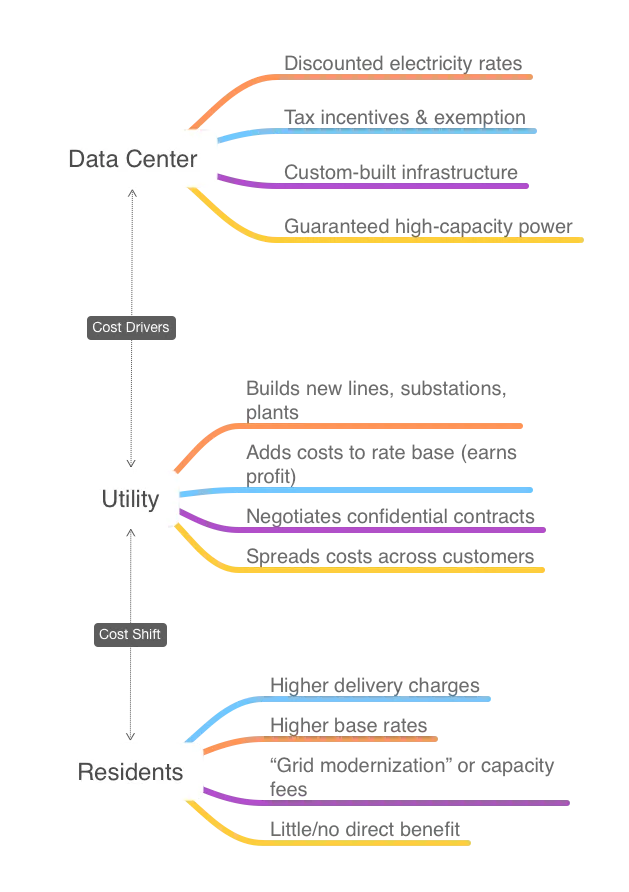
Data centers get:
- discounted electricity
- tax incentives
- custom infrastructure
- guaranteed high-capacity power
Utilities get:
- more capital investment (= more profit)
- guaranteed cost recovery
- stable long-term demand
Residents get:
- higher bills
- no direct benefit
- little job creation
- minimal transparency
As the Harvard analysis bluntly states, utility monopolies have powerful incentives to “hide subsidies for trillion-dollar companies in power prices,” shifting costs to the public while increasing their own profits.
This imbalance is why more communities are starting to question whether data centers create enough local value to justify the long-term financial burden placed on households.
Closing: A Call for More Transparent Cost Sharing
This post isn’t meant to argue against data centers. They are essential to modern digital life and can bring some economic benefits to local regions.
But the way we fund the electrical infrastructure behind them is often opaque, and the burden quietly falls on people who never directly interact with these facilities.
As more data centers come online across the country, we need:
- clearer, fairer cost-sharing agreements
- more transparent utility filings
- independent oversight outside utility-controlled analysis
- better communication with residents
- stronger scrutiny of incentives and contracts
A fairer system would ensure that the parties who create the demand also pay their proportional share—rather than shifting costs onto households who receive little in return.
References
‘Extracting Profits from the Public: How Utility Ratepayers Are Paying for Big Tech’s Power’
Comments